Should I buy a portable projector or a smart TV for a rented flat where I cannot drill walls
For a Rented Flat Where You Cannot Drill Walls: Portable Projector or Smart TV?
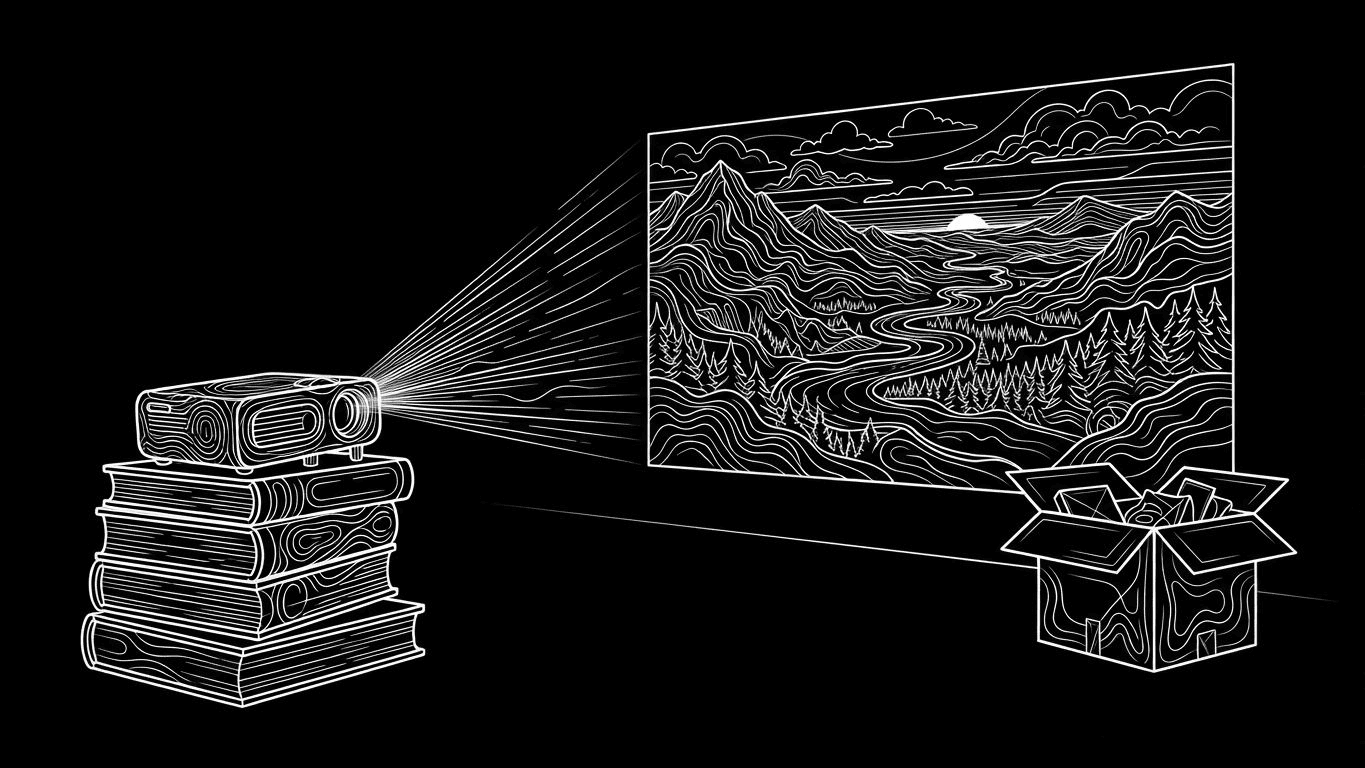
The short answer: a portable projector almost always wins for renters who cannot drill walls. A smart TV demands a wall mount, a TV unit, or both. A portable projector sits on a shelf, a stack of books, or its own stand, and throws a 100-inch image onto any pale wall or ceiling. When you move out, you take it in a bag. No holes, no arguments with your landlord, no deposit deductions.
But "almost always" is doing real work in that sentence. There are specific situations where a smart TV still makes more sense, and this guide will tell you exactly which camp you fall into.
Key Takeaways
- Portable projectors need zero wall drilling and move with you when your lease ends.
- A projector can produce a 100-inch image at a fraction of the cost of a 100-inch TV.
- Smart TVs win in brightly lit rooms and for daytime sports viewing.
- Modern laser projectors are rated for 20,000 to 30,000 hours, so longevity is not the trade-off it used to be.
- For most renters in India watching content in the evenings, a portable projector delivers more screen per rupee with zero installation hassle.
Why the "No Drilling" Constraint Changes Everything
Most smart TV advice assumes you own your home. You do not. That changes the calculation immediately.
A 55-inch smart TV without a wall mount needs a TV unit or sideboard. That is another piece of furniture to buy, move, and potentially damage the floor with. A 65-inch or larger TV becomes genuinely awkward to position without anchoring it to something. And if you want the screen at eye level while seated, you are either buying a tall stand or accepting a suboptimal viewing angle.
A portable projector eliminates this entire problem. You place it on a surface, point it at a wall, and you have a screen. According to XGIMI's buying guide, for renters or frequent movers, large TVs can be difficult to move and install, whereas projectors are lightweight and easy to carry, better suited to people who switch flats frequently.
That is not a minor convenience. In a rented flat, it is the difference between a setup that works on day one and a setup that requires two weekends, a furniture delivery, and a conversation with your landlord about whether you can put rawl plugs in the wall.
[RENTAL FLAT] ──▶ [NO DRILL RULE]
          ┌─────────┴─────────┐
          ▼                   ▼
     (SMART TV)          (PROJECTOR)
          │                   │
   Needs Furniture      Sits on Shelf
   Fixed Position       Move Anywhere
   Heavy to Move        Fits in Bag
Setup logistics comparison for rental housing.
Should I Buy a Portable Projector or a Smart TV for a Rented Flat Where I Cannot Drill Walls: The Screen Size Argument
This is where the projector case becomes genuinely hard to argue against.
According to Projector Point, a budget 1080p projector can produce a 100-inch image, whereas getting a TV with a similar screen size usually costs thousands of pounds. The same pattern holds in the Indian market. A 100-inch TV is not a realistic purchase for most renters. A portable projector that produces a 100-inch image is.
XGIMI's research confirms that home projectors commonly offer screen sizes of 100 to 200 inches, with some models reaching 300 inches, far larger than typical smart TVs in the same price range. In a rented flat where you cannot mount a TV, the projector gives you a cinema wall. The TV gives you a screen on a sideboard.
For movie nights, this is not a close comparison.
Where Smart TVs Still Win
Honesty about trade-offs matters here. There are three scenarios where a smart TV is the better call, even for renters.
Bright rooms with no blackout curtains. Projectors need controlled light to perform well. If your flat has large east-facing windows and you watch television in the morning or afternoon, a smart TV will deliver sharper, more consistent brightness. As The Projection Room Store notes, TVs generally offer better brightness and sharpness, especially in lit rooms. A projector in full daylight is a compromised experience.
Sports and live content during the day. According to Soundcore, if you watch sports and shows during the day with lots of ambient light, a TV may feel more practical. Fast motion, bright kits, and real-time action read better on a TV in a lit room.
Small flats with no suitable projection wall. If your flat has dark paint, textured walls, or no clear wall space of at least 2 metres, a projector's image quality suffers. A pale, smooth wall is the projector's canvas. Without one, you either buy a projection screen (another piece of furniture) or accept a degraded image.
If none of these three apply to you, the projector wins.
┌───────────────────┬───────────┐
│ SCENARIO          │ WINNER    │
├───────────────────┼───────────┤
│ Daylight Viewing  │ Smart TV  │
│ Movie Nights      │ Projector │
│ Limited Space     │ Projector │
│ Live Sports (Day) │ Smart TV  │
│ Frequent Moving   │ Projector │
└───────────────────┴───────────┘
Scenario-based hardware selection guide.
The Longevity Question: Is a Portable Projector a Short-Term Fix?
A common concern is that projectors burn out quickly and become expensive to maintain. This was true of lamp-based projectors from a decade ago. It is not the reality of modern portable projectors.
According to AWOL Vision, modern laser projectors are typically rated for 20,000 to 30,000 hours of use, equivalent to about 4 hours per day for 17 or more years. At that rate, a portable projector you buy for your rented flat today will likely outlast three or four lease renewals, a house purchase, and whatever living situation comes after that.
Lamp replacement costs, the traditional objection to projectors, are largely irrelevant for LED and laser-based portable units. The maintenance argument no longer holds.
The Audio Reality Check
One honest limitation: most portable projectors have built-in speakers that are adequate but not impressive. A smart TV's built-in audio is typically in the same category. Neither is a proper home audio setup.
As Nexigo's guide notes, many modern portable projectors feature built-in speakers and can project onto walls, but for enhanced contrast and audio, pairing with a portable Bluetooth speaker or soundbar makes a meaningful difference. The good news: a Bluetooth speaker is portable, requires no drilling, and moves with you. This is still a no-drill solution.
What to Look for in a Portable Projector for a Rented Flat
Not all portable projectors are equal. For a rented flat specifically, prioritise these:
Keystone correction and autofocus. You will not always be able to place the projector at the perfect angle. Automatic keystone correction means you get a rectangular image even when the projector is offset. Without it, you will spend ten minutes manually adjusting every time you move the unit.
Battery or standard power options. A projector that runs on battery is the most flexible option for a rented flat. You are not tethered to a specific power socket.
Built-in streaming OS. A projector with a built-in smart platform means one fewer device. No streaming stick to manage, no additional HDMI cable to route.
Brightness rated for your room. For a typical Indian flat with controllable light, 500 to 800 ANSI lumens is workable for evening viewing. If you have poor light control, aim higher.
Lumio's Portable Projectors: Built for Exactly This Situation
Lumio builds portable projectors specifically for the Indian home, including the rented flat reality where drilling is off the table and space is at a premium. The Lumio Arc and Lumio Vision lines are designed around the idea that your entertainment setup should move when you do, not anchor you to one wall in one flat.
Both models are built with the Indian consumer in mind: compact enough to fit on a shelf or bedside table, smart enough to run streaming apps natively, and bright enough to deliver a proper cinematic image on a standard white wall in the evening. If you have been putting off a proper home entertainment setup because you are renting, this is the setup that removes that excuse.
Frequently Asked Questions
Can I use a portable projector on a painted wall in a rented flat?
Yes, provided the wall is a light colour (white or off-white works best) and has a reasonably smooth texture. Dark or heavily textured walls reduce image quality noticeably. If your walls are dark, a freestanding portable projection screen is worth considering. It requires no drilling and folds away when not in use.
Will a portable projector work in a small flat?
Most portable projectors can produce a usable image from as little as 1 to 1.5 metres of throw distance. Check the minimum throw distance for the specific model you are considering. For a 100-inch image, you typically need 2.5 to 3 metres of distance, which is achievable in most living rooms.
Is a smart TV easier to set up than a portable projector in a rented flat?
A smart TV without a wall mount is straightforward if you have a suitable surface. A portable projector is equally simple: place it on a flat surface, connect power, and project. Neither requires drilling. The projector's advantage is that it gives you a much larger image from the same footprint.
What happens to the projector image when someone walks in front of it?
The image is temporarily interrupted, the same way a shadow crosses a TV screen when someone walks in front of it. This is a real-world consideration for high-traffic living rooms. Ceiling mounting (which would require drilling) eliminates it. For a no-drill setup, positioning the projector at a high shelf or elevated surface reduces the problem significantly.
Does Lumio make projectors suitable for rented flats?
Yes. Lumio's portable projector range is designed for exactly this scenario: compact, no-installation-required, and smart enough to run streaming apps without additional devices. The Lumio Arc and Lumio Vision are both worth evaluating if you are setting up a home entertainment system in a rented flat.
How does a portable projector compare to a smart TV for everyday use?
For evening viewing, streaming, and movie nights, a portable projector matches or exceeds a smart TV on screen size and immersion. For daytime use in a bright room, a smart TV has the brightness advantage. Most renters who primarily watch content in the evenings find the projector the more satisfying long-term choice.
If you are ready to stop compromising on screen size because you rent, explore what Lumio has built for exactly this situation. Portable projectors that deliver genuine home cinema without touching a single wall.
____________________________________________
L U M I O  |  Portable Cinema Specialists
--------------------------------------------
Lumio: Portable Cinema Specialists